Nautical Quilted Pillow Cover

pillowslider

My new color crush is navy blue.  Especially that chevron navy blue I did in my Quilted Camera Strap.  So I’m slowly transitioning the purple accents in my living room to navy blue.

By the way–I am SO excited to move to my new place.  It’s going to be so much bigger and it has a ton of light coming in.  (Cue angels singing and Heaven opening.)

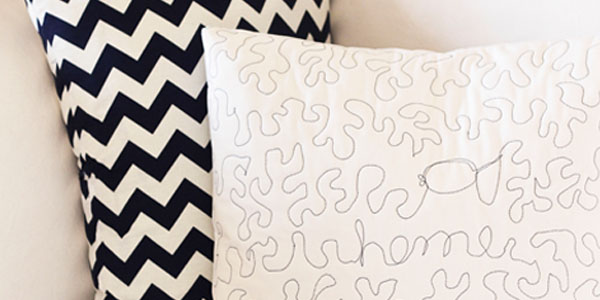
So I whipped up some pillow cases this week, one from the Navy Chevron, done in my 10 Minute Pillow Case method–seriously SO fast, I love it!  And the other I quilted with navy blue thread.

If I were to do this again, I would have quilted the word “beach” or “coast” or something more ocean-related. And I would have gone slower. But I am an impatient person…you should know that about me by now :)

The style of free-motion quilting I did was one I kind of invented–Coral, to imitate the coral found in the ocean. Kind of looks like seaweed too.  And I threw in some rough “sketches” in there too.

Here’s the rundown:

First, you take the pillow that you want to cover and cut out TWO squares about the same size but with a couple of inches extra.  One can be in muslin because it’s just the back of the quilted piece which you won’t see.  Then cut two pieces of fabric 2/3rds the length of the square you just cut (but same height.)  Those will be for the back.


The next step is basting.  This is just like the Quilted Camera Strap–very quick and easy basting.  You need to get a basting spray.  I have Sullivan’s Original Quilt Basting Spray (the pink can) which has been great.  Just spray each layer, put it together like a batting sandwich (yummmm….batting sandwich…) and smooth out all the wrinkles.


Then use your free motion foot or darning foot to quilt it.  You can go slowly if you are unsure but I like to go fast–it’s a rush!  For the coral pattern you just kind of “draw” it as you go.  I started out doing the typical puzzle quilting but then added the coral affect into it.  You can also draw in a fish or a word or something.  It’s just fun!


After you’ve quilted it, you will assemble the pillowcase.  Trim your quilted piece to a square with straight edges.

Then take the two back side pieces and turn one edge under two times at a 1″ thickness.  Iron the edges down.  Then sew them down.


Place the right sides of the two back pieces against the right side of your quilted piece.  Overlap the two finished edges of the back to make the envelope enclosure.  Pin the sides.

Sew the perimeter with a 3/8ths seam allowance (that’s lining up the edge of the presser foot with the side).  Clip the corners and flip it right side out.


Makes a great cuddler for a cute baby, right?

 Linking up to

Home Stories from A to Z

Pin It

Share and Enjoy

Deer Family Pillow by Infarrantly Creative!

Hello Honeybear Lane fans. I am Beckie author of Infarrantly Creative, Roadkill Rescue and Knock Off Décor. Yes, I am busy. I have been obsessed with two things lately: making pillows and the Simply Screen Kit from Plaid. I saw this Holiday Deer Throw Family Pillow cover from Red Envelope that is not only $50 but is also sold out! Not that I would purchase it anyway but I sure would recreate it myself.red envelope pillow

deer pillow family

Supplies:

Pillow cover (I got mine from Ikea: Aina Pillow Cover $6)

Simply Screen Kit

White Simply Screen paint

Design program

White printer paper

Scotch Blue Painter’s Tape

1. I designed a replica of the pillow I saw on Red Envelope making sure the images I wanted white were actually black in the design.holiday deer throw pillow

2. I printed out my design and then cut it down to fit the largest screen in the kit.

deer pillow (6)

3. Then I peeled the backing from the screen and burnished my print out onto the sticky side of the screen.

deer pillow (8)

4. Then I put a piece of glass over my image (image and screen side down) to really hold it down so the image would stay in tact when I exposed it.

deer pillow (9)

5. Then I put it under the light box for exactly 25 minutes (SET A TIMER!).

deer pillow (14)

6. I peeled back the paper and soaked my screen for 30 seconds. With my kitchen sprayer and a sponge I wiped away the emulsion until all of my image was a clear screen. Then I let my screen dry.

Simply Screen screenprinting

7. Next I marked the center of my pillow cover and then got my screen and taped it down with Scotch Blue painters tape.

deer pillow (18)

8. I squirted two lines of Simply Screen paint and then drug it over my image pulling the paint into the screen. I used a thick coat and covered the entire image. I let it sit for two minutes and then I added another coat (since it was a lighter colored paint on a dark fabric).

deer pillow (12)

9. Then I peeled off the tape. I pulled back the screen to reveal my print.

deer pillow (2) deer pillow (3)

Woo-hoo! It is beautiful! Then I let it dry. Using a press cloth I ironed it to set the print. Then I popped a pillow in it and admired it on couch.

family pillow

If you want to see more of my pillows I have made this month click here.

Christmas Subway Art advent calendar pillow

Share and Enjoy

Applique Pillow with Piping Tutorial

So you know how to applique and you know how to make a pillow.  Do you know how to do piping?  (yes?  Okay…just humor me.)

Supplies:
Applique
Fabric for pillow
Fabric for piping (fat quarter)
Pillow form or stuffing
Cording

To do a name, I printed out the name from my computer in a ginormous font
Then I used the printout as a stencil for my adhesive-backed fabrics
I wanted some zebra stripe, but not to overpower the applique, so I fused it to some muslin
So you can see the zebra through the muslin.  Then I sewed the applique on and sewed a zigzag border
Now onto the piping:  First make the casing for piping using the Continuous Binding Tutorial (or you can just sew some strips together since you don’t need that much.)
Get out your cording…this is what it looks like. 
Get out your zipper foot
To sew the piping, shove the cording in the fold nice and snug.  Then sew a seam right next to the cording (the zipper foot allows you to get really close to the cording so it’s super snug.)  Sew enough piping to go around your pillow.
After you’ve sewn the piping, pin it to the top of your pillow, lining up your raw edges.  Leave a few inches of overhang.
Clip the corners to make it easy for pinning
To join your piping, unpick a few stitches and fold back the fabric to expose the cord.  Clip the cord.
Line up the cords, and fold your fabric under.  Then pull the fabric back over the joint, covering it up.
Pin it!
Sew the piping on.  You can actually put the back on here, but I never do because I’m worried it will turn out horribly.  As always, stitch right next to the cording.
It should look like this.
Pin your back on, right side facing in.  Then sew a seam on the outer edge of the piping (feel it as you go.)  Leave an opening so you can turn it inside out!  (You can also make this a pillow case, but you need to see this tutorial.)
Trim the edges and corners and then turn it right side out.
Put in your form or stuffing night and snug!  Then whipstitch it closed.
There you have it!  I love piping!

And speaking of which…how are your applique projects coming for:

I know the deadline is still a couple weeks away, but I haven’t gotten very many entries yet.  
Come on, don’t let me down, guys!

blog sig

Share and Enjoy

Snowflake Pillowcase Tutorial!

Materials needed:

  • At least two contrasting fabrics (I used old t-shirts and solid color cotton) 1 yard for case, 1/2 yard for snowflakes (or scraps…just use scraps.)
  • Pillow form (I used an old pillow we already had)
  • Iron-on adhesive (like Wonder Under)
 My old t-shirt (you saw this yesterday…) I just hacked it all up and used the back, saving the graphic side for another project.  I ironed the Wonder Under on one side. 
Step 1:  Using your pillow as a guide, cut one piece of fabric (the case part) for the front of the pillow. 
Step 2:  Using that piece as a guide, cut a second piece about four inches longer.
Step 3:  Cut that piece in half
Step 4:  Using the two back pieces, fold one long edge over 1/4 inch, then a half inch (approximately, I don’t measure.  Just make sure the two pieces end up as the same size as the front piece.) Iron the folds down. 
Moving onto the snowflake part.  Here is my pile ‘o’ scraps with Wonder Under on one side.
Step 5:  Cut your pieces into small squares
Step 6:  Fold in half, right sides together
Step 7:  Fold in half again (you know where this is going…)
Step 8:   ….aaaaand again….
Step 9:  Start cutting, like you did back in kindergarten, making snowflakes.  Make sure to clip the top of the folds to create some interest.
This is what it looks like when you clip it like that.  You can also round it out.  Heck, do what you want…I’m no snowflake expert.  I had to practice on paper first to make sure it didn’t look completely awful. 
Step 10:  Cut in the folded sides, even the unfolded sides.  Also clip the folded corner.  It looks much better this way. 
Here is my snowflake.  I actually changed it a little after unfolding it.  Whatever…I do what I want! 
Step 11:  Finish cutting out the rest of your snowflakes, then lay them out on the pillow top to see how you want them arranged.  Make sure to do it on the pillow so you can really center them.  And then iron them on…ironing one at a time, leaving the iron on the fabric for about 3-5 seconds so it can bond.
Step 12:  You can leave it like that.  But since I was using a knit fabric, I wanted to do this step.  It doesn’t work the same with cotton.  If you like the border, cut some 1/2 inch wide strips from a knit fabric.  Stretch the strips so they curl.  The arrange the strips on the pillows how you like, curl side up.  
Step 13:  Sew the strips down, pulling the fabric as you go so that it stays curled up. 
Step 14:  Lay right sides of your pillowcase together.  Since the back side is two separate pieces, lay the hemmed sides one on top of the other.  Pin in place.  Sew around the entire square, with a 1/2 inch seam allowance (approx.)
Step 15:  Turn inside out by the natural slit you made in back. 
Step 16:  Put your pillow insert in the case.  Aw, so cute.  Go put it on your bed and admire.  Or, if you’re like me, go make your bed and THEN put it on your bed and admire.  

Who wants to make this and post it to the Honeybear Lane Flickr?  You, you, and YOU!

blog sig

Share and Enjoy

Puffy Pillow Tutorial

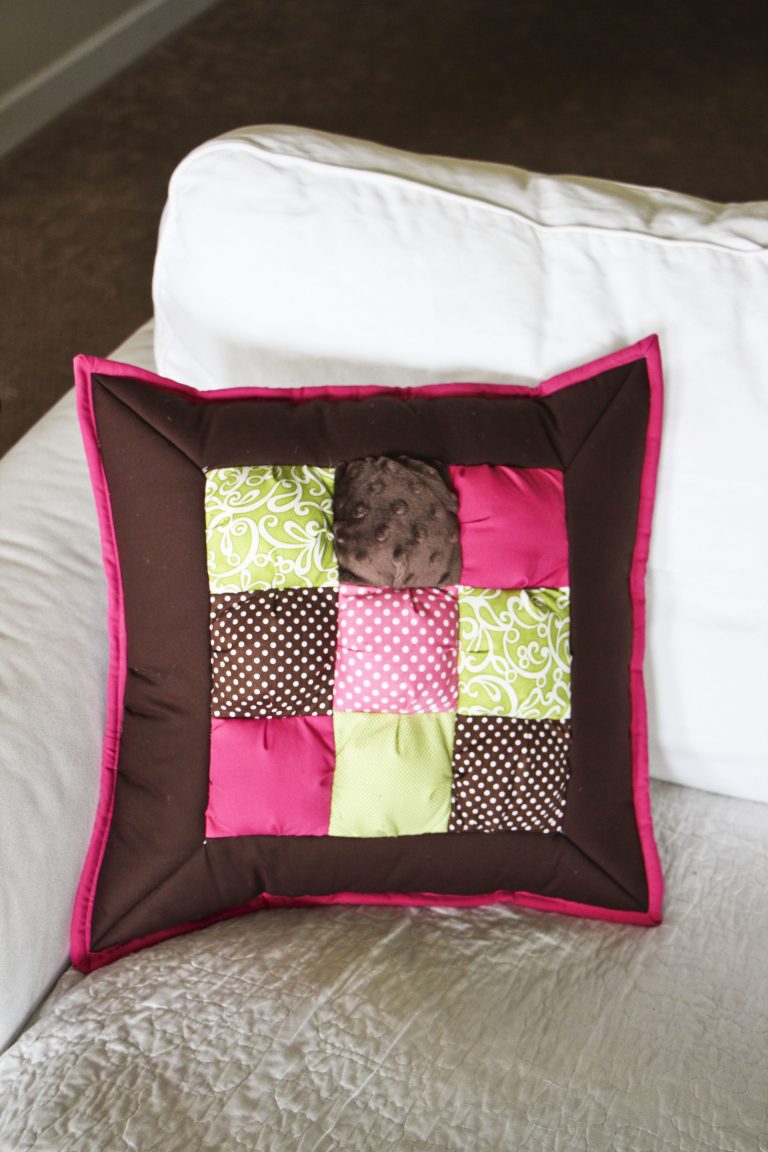
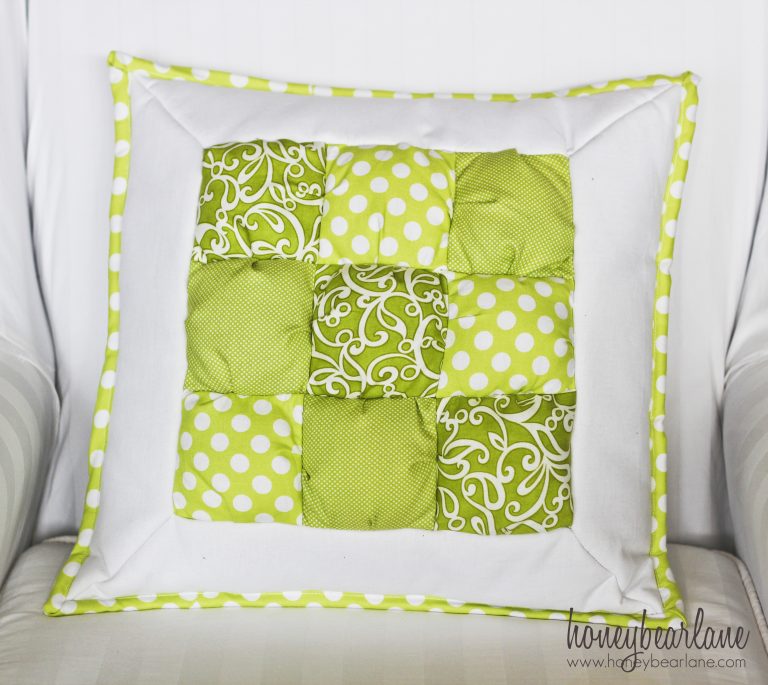
Have you been following the Puff Quilt tutorial but don’t feel up to the challenge?  You can start with this little half-hour project!

Front
Back
Step 1:  Piece together 9 puffs, as per the Puff Quilt instructions
Step 2:  Cut out a coordinating square of fabric, the same size as the pillow top
Step 3:  Lay the right sides together
Step 4:  Pin the sides together
Step 5:  Sew all around, making sure to envelop the existing seams
Step 6:  Leave a small opening for you to turn it inside out
Step 7:  Turn it inside out, poke out the corners real good
Step 8:  Fill the pillow with poly-fill (the same stuff you use to fill the puffs
Step 9:  Fold the raw edges of the opening under and pin shut
Step 10:  Whip stitch shut by hand
Step 11:  Can barely see it!
The pillow so far…you can leave it like this.  But I decided to…
…tack down the corners of the puffs.  I just did this with embroidery thread:  knotting on top, sew a few stitches up and down, knot again.

You can make this pillow bigger by adding more puffs; this project was super easy! After making it…I wondering if it would look the exact same if I had just pieced squares together in the traditional way…

Share and Enjoy

Creative Commons License
This work is licensed under a Creative Commons Attribution-NonCommercial-ShareAlike 3.0 Unported License